2 min read
The footage was shot. Whether admins could build with it was still undecided.
Stakes
A quiz shows whether someone knows the policy. It can't show what they do when a customer pushes back.
So HumanEdge made a harder bet: film its own scenes and let learners play them. A bank rep, a customer with missing documents, a choice. Choose well and the story moves on. Choose badly and you watch the consequence, then try again.
The footage was the commitment. It was shot at real cost, before a single learner played it. A failed design here isn't another iteration. It's an investment that never reaches a learner.
The decision
Replace the foundation, not the labels: The old tool was a freeform canvas: admins placed and wired every scene, question, and result by hand. I polished it first, and it was still wrong.
Every simulation has one shape: a scene, then a decision. A right answer moves on. A wrong one plays a consequence clip and retries. No PM was defining the tool, so the call was mine: enforce that shape.
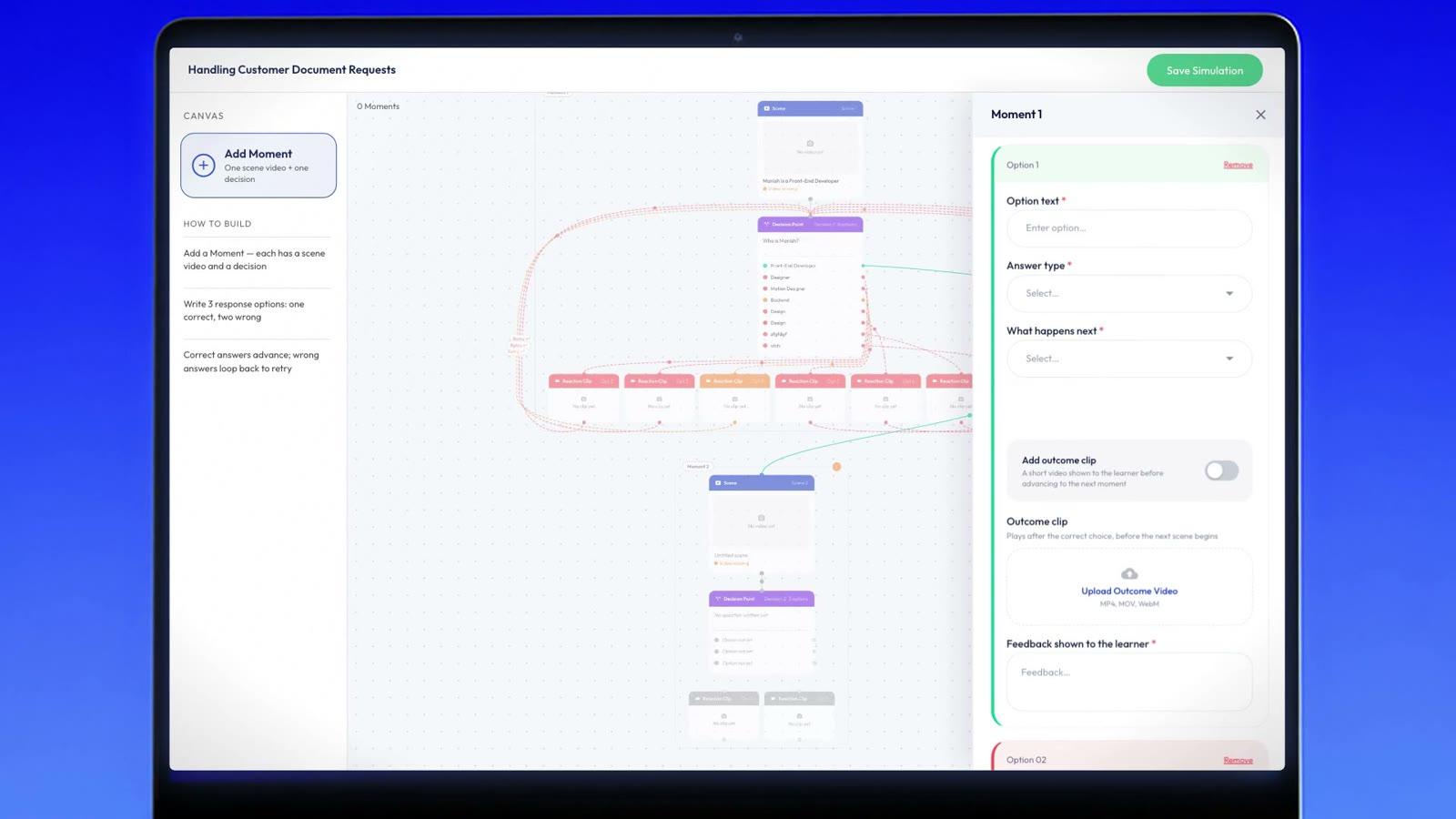
I built the Moment, one scene plus one decision. Correct advances, wrong retries, nobody draws a connection. The canvas stayed as the overview.
Put every wrong answer on the canvas: The old tool hid what a wrong choice triggered in a side panel.
Now each option has its own line to its own consequence clip, so a missing one shows before the simulation goes live.
Trade-off
I locked V1 to a straight line. A right answer can't jump ahead, and one simulation can't split into two storylines, without building a new editor.
The freeform canvas allowed that, but made admins do layout for a path that never branched. One long card per scene meant about 18 fields and no view of the whole simulation.
Every V1 simulation was linear, so I took the fit and accepted the rebuild later.
Outcome
Adding a simulation's flow dropped from about 5 minutes to 2, resulting in 60% faster completion.
Reflection
My first pass polished the canvas: good polish, wrong foundation.
I treated the interface as the problem when the model underneath was. Now I ask what shape the content has before I touch a screen.
Good polish, wrong foundation.